The Hidden Trap of Push-Button Logos and Empty Brands
Imagine spending months pouring your heart, savings, and sleepless nights into building your dream business. You finally reach the launch phase, and you want to save a bit of money on your visual look. You visit a popular AI design software platform, type in three keywords, and press a shiny blue button.
Within five seconds, the screen flashes and presents you with ten neat, colorful logos. You pick one, feel a brief rush of excitement, and launch your business with pride. But a few weeks later, you notice three other local businesses using almost the exact same layout, icon, and font.
Your heart sinks as you realize your business looks like a carbon copy of everyone else. Your visual identity has no soul, no unique story, and absolutely no emotional pull. You feel invisible in a crowded market because a cold algorithm treated your dream like a simple math equation. This is the quiet heartbreak that thousands of new business owners face when they rely entirely on automated tools.
The Science of Branding: Why Algorithms Miss the Mark
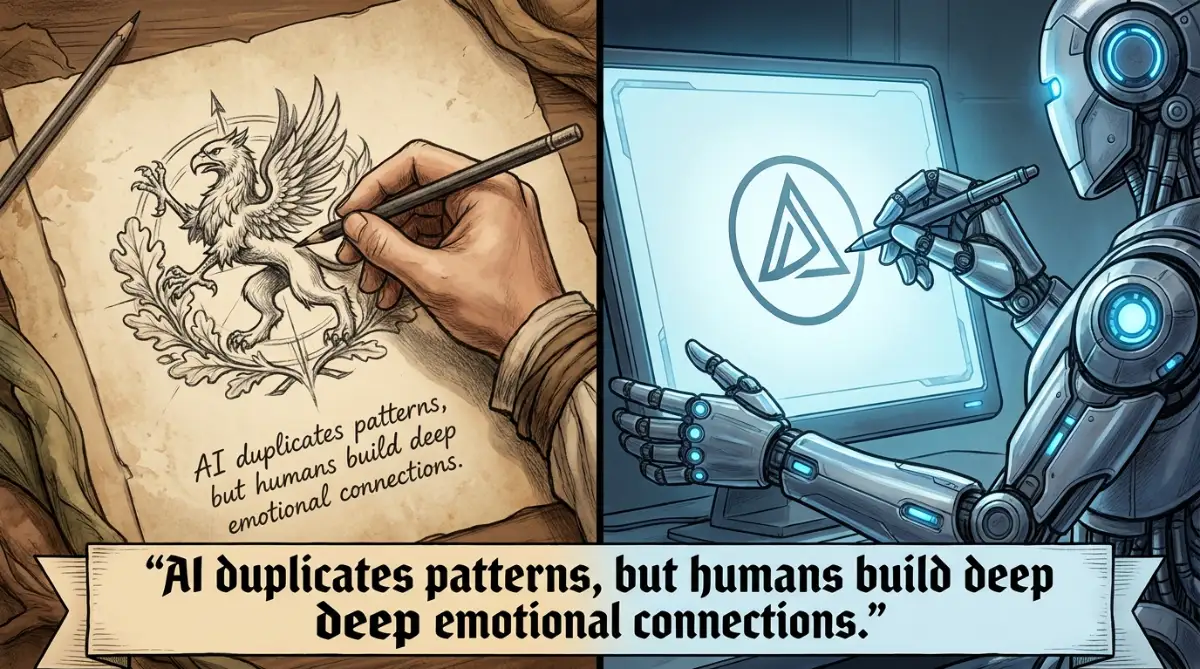
To understand why this happens, we must look at how automated tools actually function. AI software does not create anything truly new from scratch. Instead, it scans millions of existing files, recognizes mathematical patterns, and mixes them together based on formulas.
It sees that 40% of organic cafes use a green leaf icon. Therefore, when you type "organic cafe," it automatically gives you a green leaf. This is not creative design; it is simply statistical prediction.
Real human creators do not look at statistics to decide what your heart should feel. They look at your personal journey, your values, and your unspoken promises to your audience. This human element is grounded in deep psychological principles that software simply cannot comprehend.
The Myth of One-Click Identity
Many software companies promise that their tools can build a complete brand identity in minutes. They claim their systems understand color psychology and typography pairings just like a professional.
But there is a massive difference between knowing a rule and knowing when to break it. An algorithm can pair a serif font with a sans-serif font because a database says they match. However, it cannot tell you if that pairing feels too aggressive for a sensitive mental health brand.
Let us look at a simple comparison of how these two approaches operate in the real world:
Why Human Empathy is the True Seed of Branding
Great design is not just about placing a circle next to a square. It is about understanding the human condition, our fears, our desires, and our quiet struggles.
When you sit down with a professional designer, they do not just ask for your favorite colors. They ask about your childhood memories, your struggles, and what makes you wake up in the morning. They listen to the tone of your voice when you talk about your customers.
This empathy allows them to build a visual bridge between your heart and your audience. An algorithm cannot feel empathy. It does not know what it feels like to take a risk, to fail, or to succeed. Because it cannot feel, it cannot design things that make others feel.
Pro Tip: Your brand is not just a logo; it is the gut feeling someone has when they hear your business name. AI can make a pretty shape, but only a human can build a lasting gut feeling.
The Power of Cultural Nuance
Colors and symbols mean different things in different parts of the world. A specific shade of white might represent purity in one country, but it represents mourning in another.
A human designer understands these deep cultural layers and adapts your visual look accordingly. They know how a local community will react to a specific symbol or layout.
AI tools struggle with these subtle cultural shifts because they analyze data on a global, flat scale. They often miss the tiny local details that can make or break your business reputation.
The Cost of the "Cheap and Fast" Mental State
It is highly tempting to use a tool that costs ten dollars and takes five minutes. We live in a world where speed is highly valued.
But cheap tools often cost you much more in the long run. If your visual identity looks cheap, people will assume your service or product is also cheap.
[Generic AI Logo] ---> [Weak Brand Trust] ---> [Low-Value Customers] ---> [Business Failure]
When you invest in a human creator, you are investing in a strategic partner who protects your business image. They make sure your first impression is highly professional, trustworthy, and completely unique.
The Nightmare of Trademark Battles
If you use a tool that generates visuals from a shared database, you do not own the unique rights to that art. Anyone else can generate the exact same icon tomorrow.
This can lead to severe legal issues if another business claims you copied their look. Human creators build your identity from a blank canvas, ensuring your visual marks are completely original.
They help you secure your trademarks so you can grow your business with complete peace of mind. This legal safety is something a computer program can never guarantee.
How to Work with Both: The Human-Led Approach
We must clarify that automated tools are not completely useless. They can be helpful in the very early stages of brainstorming.
You can use them like a digital sketchpad to throw ideas around or see color combinations. But the final work must always be guided, refined, and completed by a human hand.
- Use AI for: Quick mood boards, exploring basic color palettes, and generating rough layout ideas.
- Use Humans for: Deep strategy, custom typography, cultural adjustments, emotional alignment, and final production.
By keeping the human creator at the center of the process, you ensure your brand retains its heart and soul. You get the speed of modern technology combined with the deep wisdom of human experience.
Crafting a Story That Sticks
People do not fall in love with corporations; they fall in love with stories. Think of your favorite brands in the world today.
You do not love them because their logo is mathematically perfect. You love them because of how they make you feel when you open their packaging or use their services.
A human creator knows how to weave your personal values into every single touchpoint of your business. They create a consistent visual language that tells a story across your website, packaging, and social media. This storytelling ability is the ultimate key to building a loyal community that stands by you for years.
Mastering the Long-Term Alignment of Your Brand Assets
Creating a Simple Visual Guide Book
How does a brand stay strong over five or ten years? The answer lies in a clear set of rules that keep your colors, fonts, and style exactly the same across all platforms.
When you work with a real human creator, they do not just hand you a logo file and walk away. They build a customized brand guide that explains how to use your visuals in the real world.
According to research on usability standards by the Nielsen Norman Group, maintaining visual consistency is a primary requirement for building trust with your audience. When your social media posts, website, and physical packaging match perfectly, people feel that your business is stable and reliable.
Doing Regular Checks on Your Brand Health
Your business is a living thing, and it will change as you offer new services or reach new customers. Every six months, you should look at all your public-facing files to make sure they still tell the correct story.
If you notice that your graphics are looking a bit messy or disconnected, it is time to do a quick clean-up. A professional designer can help you adjust your existing look without losing the trust you have already built.
Building a solid business is a long journey that requires patience and smart cash management. If you are struggling with startup costs to hire professional designers, it is smart to explore safe alternatives to equity loans for fast emergency cash instead of rushing into risky debt agreements.
Why the Physical Health of the Founder Matters
Most business owners spend all their time staring at screens trying to fix design problems themselves. This intense focus can lead to physical fatigue, back strain, and mental burnout.
You cannot build a successful brand if you are constantly feeling physically exhausted. To keep your focus sharp and your creative energy high, you must take care of your body by eating the best anti-inflammatory foods for joint pain relief to protect your health during long planning sessions.
When your body feels strong and pain-free, you make better decisions for your company. Taking regular breaks to stretch and resting your eyes will help you see your brand goals with complete clarity.
The Human Mindset vs. Machine Automation
Machines can follow instructions, but they do not have a vision for your future. A human brand creator looks at where you want to be in ten years and designs for that specific destination.
They think about how your visual style will look on a massive billboard, a tiny phone screen, or even embroidered on a warm sweater. This level of forward-thinking keeps your brand from looking outdated after just a few months.
Organizations like the AIGA focus heavily on these professional design standards, emphasizing that true design connects the intellect and the human heart. A machine can only process mathematical equations; it has no true sense of long-term vision.
Balancing Technology and Human Skills
The secret to modern brand success is not ignoring technology, but using it in a smart way. You can use automated software to quickly generate basic mood boards or see color combinations.
But once the brainstorming is done, you should hand those ideas over to a human designer who can refine them with skill and care. This hybrid method gives you the efficiency of computer tools while protecting the unique soul of your brand.
It keeps you from ending up with a generic look that blends into the background of your industry. By keeping human artistry at the center of your plans, you build an identity that truly stands out.

Deep Mistakes That Keep Your Brand in the Shadows
The Trap of Choosing Speed Over Originality
The biggest mistake new business owners make is rushing to launch with a cheap, automated graphic. They think that having any logo is better than having no logo at all.
But a generic visual mark actually hurts your reputation before you even get a chance to introduce yourself. Customers are highly intelligent, and they can spot a templated, robotic design from a mile away.
When they see a generic design, they subconsciously assume that your services will also be generic and lazy. You end up losing high-value clients who would have gladly paid top price for your unique skills.
Falling into the Software Subscription Debt Loop
Another common error is spending hundreds of dollars on multiple AI tools to try and design everything yourself. You might end up paying monthly fees for logo generators, color wheel tools, and template websites.
These small fees quickly add up, draining your business bank account before you make your first sale. Many creatives and business owners get trapped in a cycle of paying for tools they do not even know how to use properly.
Getting stuck in debt while trying to pay off expensive, useless software subscriptions is a bad financial trap. You should protect your capital early on and find ways to stop paying minimums on your debts to keep your cash flow healthy.
Over-complicating Your Message
When people try to design their own visuals, they often try to say too many things at once. They want their logo to show their location, their history, their products, and their values all in one tiny icon.
The result is a messy, confusing design that is impossible to read or remember. A human brand creator knows how to simplify your message down to its absolute essence.
They remove the noise and leave only the pure, powerful core of your story. This simplicity is what makes your brand stick in the minds of your customers for years.
Ignoring the Real Needs of Your Target Audience
A design should never be based solely on your personal favorite colors or trendy art styles. It must be designed for the specific group of people you want to serve.
AI software often generates bright, flashy icons because those are popular in its global database. But if you are building a quiet, high-end finance consulting firm, those flashy colors will drive your target clients away.
Human designers spend hours researching your specific audience before they even draw a single line on paper. They study what your clients read, where they shop, and what makes them feel safe and comfortable.
The Illusion of "Good Enough" Visuals
Many business owners look at a machine-generated graphic and say, "This is good enough for now." But in the business world, "good enough" is often the enemy of greatness.
When you settle for average, you accept average sales and average growth. Your brand identity is the foundation of your entire business house.
If your foundation is weak or generic, the rest of your marketing efforts will eventually fall down. Investing in professional art from the very beginning saves you from the pain of a complete redesign later on.
Your Personal Action Plan for a Standout Identity
Step One: Define Your Core Story
Before you open any design program or hire a professional, sit down with a piece of paper. Write down the answers to three simple questions that define your business soul.
First, why did you start this business instead of doing something else? Second, how do you want your customers to feel when they interact with you?
Third, what is the single biggest promise you make to everyone who buys from you? These answers are the true foundation of your brand identity, and no algorithm can write them for you.
Step Two: Find Your Perfect Creative Partner
Once you have your story clear, look for a human designer whose style matches your personal vision. Do not just look at their online portfolio; talk to them directly to see if they understand your dreams.
A good creative partner will ask you deep questions and challenge your assumptions in a helpful way. They will collaborate with you to build something that feels completely authentic to your path.
This human connection is the magic key that transforms a simple business into a beloved brand. You will feel a sense of pride and confidence that no automated template generator could ever give you.
Your Action Plan for Tomorrow
To help you move forward with confidence, here is a simple checklist you can start using tomorrow:
- Review your current logo: Ask three friends if your visual mark feels warm and human or cold and generic.
- Write down your values: Put your brand's core mission into three simple sentences that anyone can understand.
- Research local designers: Look for creative professionals in your community who understand your local market.
- Set a realistic budget: Save up a dedicated fund specifically for your visual identity instead of rushing into cheap options.
A Quick Scenario: The Bakery Story
Let us look at a real-world scenario of a small bakery owner named Arthur. He wanted his brand to feel warm, cozy, and reminiscent of his grandmother's old kitchen.
He tried using an AI graphic tool to save money during his first month. The tool analyzed his input and gave him a clean, sharp, modern icon of a wheat stalk inside a perfect circle.
It was neat and mathematically correct, but it felt cold, corporate, and completely missed the warm, emotional cozy feeling Arthur wanted. When he finally hired a local designer, she spent an afternoon eating his pastries and listening to his family history.
She then hand-draw a slightly imperfect, beautiful illustration of an old brick oven with gentle smoke rising from the top. That warm, imperfect design immediately told his story and made his customers feel like they were stepping into a loving home.
Frequently Asked Questions About Brand Design
Can I use AI tools just to get quick ideas for my brand?
Yes, automated generators are excellent for brainstorming and seeing many quick visual concepts in one place. You can use them to test color mixes or explore basic layouts. However, you should always hire a professional human designer to create the final, custom files that you will use in your business.
Is hiring a human brand creator always expensive?
Not necessarily, because there are designers for almost every budget level. You must view this cost as a long-term investment rather than an expense. A strong, custom look will help you attract higher-paying clients and grow your business much faster than a cheap, generic template ever could.
What if I already launched my business with an AI logo?
It is never too late to refresh your visual style. Many successful companies start with a simple logo and update their look as they grow. You can work with a professional creator to do a gentle update that keeps your current customers while raising your overall brand value.
Disclaimer
This article is for informational and educational purposes only. The brand strategies, design principles, and business financial tips shared here are based on general industry standards and experiences. For specific legal, trademark, or heavy financial decisions, please consult with a qualified professional attorney or financial advisor.